There is one rule for the industrialist and that is: Make the best quality of goods possible at the lowest cost possible, paying the highest wages possible

Showing posts with label Tsunami. Show all posts

Recovery slow as Japan marks 2 years since tsunami


Recovery slow as Japan marks 2 years since tsunami — Amid growing dissatisfaction with the slow pace of recovery, Japan marked the second anniversary Monday of the devastating earthquake and tsunami that left nearly 19,000 people dead or missing and has displaced more than 300,000.

Japanese Prime Minister Shinzo Abe said that the government intends to make "visible" reconstruction progress and accelerate resettlement of those left homeless by streamlining legal and administrative procedures many blame for the delays.

Relatives of of the March 11, 2011 earthquake and tsunami victims offer chrysanthemums during the national memorial service to pay tribute to those who lost their lives in the disaster in Tokyo, Monday, March 11, 2013. Japan marked the second anniversary on Monday of the disaster that left nearly 19,000 people dead or missing and more than 300,000 people still displaced. (AP Photo/Junji Kurokawa, Pool) 
Relatives of of the March 11, 2011 earthquake and tsunami victims offer chrysanthemums during the national memorial service to pay tribute to those who lost their lives in the disaster in Tokyo, Monday, March 11, 2013. Japan marked the second anniversary on Monday of the disaster that left nearly 19,000 people dead or missing and more than 300,000 people still displaced. (AP Photo/Junji Kurokawa, Pool)

"I pray that the peaceful lives of those affected can resume as soon as possible," Emperor Akihito said at a somber memorial service at Tokyo's National Theater.

At observances in Tokyo and in still barren towns along the northeastern coast, those gathered bowed their heads in a moment of silence marking the moment, at 2:46 p.m. on March 11, 2011, when the magnitude 9.0 earthquake — the strongest recorded in Japan's history — struck off the coast.

Japan has struggled to rebuild communities and to clean up radiation from the Fukushima Dai-ichi nuclear plant, whose reactors melted down after its cooling systems were disabled by the tsunami. The government has yet to devise a new energy strategy — a central issue for its struggling economy with all but two of the country's nuclear reactors offline.

About half of those displaced are evacuees from areas near the nuclear plant. Hundreds of them filed a lawsuit Monday demanding compensation from the government and the now-defunct plant's operator, Tokyo Electric Power Co., or TEPCO, for their suffering and losses.

"Two years after the disasters, neither the government nor TEPCO has clearly acknowledged their responsibility, nor have they provided sufficient support to cover the damages," said Izutaro Managi, a lawyer representing the plaintiffs.

Throughout the disaster zone, the tens of thousands of survivors living in temporary housing are impatient to get resettled, a process that could take up to a decade, officials say.

"What I really want is to once again have a 'my home,' " said Migaku Suzuki, a 69-year-old farm worker in Rikuzentakata, who lost the house he had just finished building in the disaster. Suzuki also lost a son in the tsunami, which obliterated much of the city.

Further south, in Fukushima prefecture, some 160,000 evacuees are uncertain if they will ever be able to return to homes around the nuclear power plant, where the meltdowns in three reactors spewed radiation into the surrounding soil and water.

The lawsuit filed by a group of 800 people in Fukushima demands an apology payment of 50,000 yen ($625) a month for each victim until all radiation from the accident is wiped out, a process that could take decades. Another 900 plan similar cases in Tokyo and elsewhere. Managi said he and fellow lawyers hope to get 10,000 to join the lawsuits.

Evacuees are anxious to return home but worried about the potential, still uncertain risks from exposure to the radiation from the disaster, the worst since Chernobyl in 1986.

While there have been no clear cases of cancer linked to radiation from the plant, the upheaval in people's lives, uncertainty about the future and long-term health concerns, especially for children, have taken an immense psychological toll on thousands of residents.

"I don't trust the government on anything related to health anymore," said Masaaki Watanabe, 42, who fled the nearby town of Minami-Soma and doesn't plan to return.

Yuko Endo, village chief in Kawauchi, said many residents might not go back if they are kept waiting too long. Restrictions on access are gradually being lifted as workers remove debris and wipe down roofs by hand.

"If I were told to wait for two more years, I might explode," said Endo, who is determined to revive his town of mostly empty houses and overgrown fields.

A change of government late last year has raised hopes that authorities might move more quickly with the cleanup and reconstruction.

Since taking office in late December, Abe has made a point of frequently visiting the disaster zone, promising faster action and plans to raise the long-term reconstruction budget to 25 trillion yen ($262 billion) from 19 trillion yen (about $200 billion).

"We cannot turn away from the harsh reality of the affected areas. The Great East Japan Earthquake still is an ongoing event," Abe said at the memorial gathering in Tokyo. "Many of those hit by the disaster are still facing uncertainty over their futures."

The struggles to rebuild and to cope with the nuclear disaster are only the most immediate issues Japan is grappling with as it searches for new drivers for growth as its export manufacturing lags, its society ages and its huge national debt grows ever bigger.

Those broader issues are also hindering the reconstruction. Towns want to rebuild, but they face the stark reality of dwindling, aging populations that are shrinking further as residents give up on ever finding new jobs. The tsunami and nuclear crisis devastated local fish processing and tourism industries, accelerating a decline that began decades before.

Meanwhile, the costly decommissioning the Fukushima Dai-ichi nuclear plant could take 40 years as its operator works on finding and removing melted nuclear fuel from inside, disposing the spent fuel rods and treating the many tons of contaminated wastewater used to cool the reactors.

Following the Fukushima disaster, Japan's 50 still viable nuclear reactors were shut down for regular inspections and then for special tests to check their disaster preparedness. Two were restarted last summer to help meet power shortages, but most Japanese remain opposed to restarting more plants.

The government, though, looks likely to back away from a decision to phase out nuclear power by the 2030s. Abe says it may take a decade to decide on what Japan's energy mix should be. ( Associated Press )


READ MORE - Recovery slow as Japan marks 2 years since tsunami

Tsunami kills at least five in Solomons after big Pacific quake


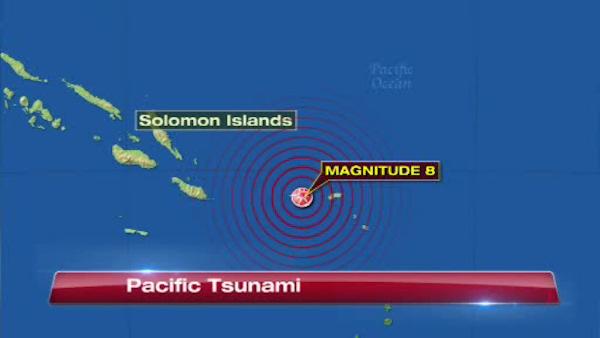
Tsunami kills at least five in Solomons after big Pacific quake - A powerful 8.0 magnitude earthquake set off a tsunami that killed at least five people in a remote part of the Solomon Islands on Wednesday and triggered evacuations across the South Pacific as island nations issued tsunami alerts.

The quake struck 340 km (211 miles) east of Kira Kira in the Solomons, the Pacific Tsunami Warning Center in Hawaii said as it issued warnings for the Solomons and other South Pacific nations including Australia and New Zealand. It later canceled the warnings for the outlying regions.


http://media.zenfs.com/en-US/video/video.reutersnews.com/2013-02-06T114526Z_2_LOVE9150WNP89_RTRMADP_BASEIMAGE-960X540_FIJI-TSUNAMI-EVACUATION-O.JPG

A tsunami measuring 0.9 metres (three feet) hit near the town of Lata on the remote Santa Cruz island, swamping some villages and the town's main airport as people fled to safety on higher ground.

More than three dozen aftershocks up to magnitude 6.6 rocked the region in the hours after the quake, the U.S. Geological Survey said.

Lata hospital's director of nursing, Augustine Pilve, told New Zealand television that five people had been killed, including a boy about 10 years old, adding that more casualties were possible as officials made their way to at least three villages that may have been hit.

"It's more likely that other villages along the coast of Santa Cruz may be affected," he said.

Disaster officials in the Solomon Islands capital Honiara told the Solomon Islands Broadcasting Corp. that they believed six people were dead and that five villages had suffered damage.

Solomon Islands Police Commissioner John Lansley said it was too early to fully assess the damage or casualty numbers, and said authorities hoped to send aircraft to the region on Thursday to help determine the extent of the damage.

Luke Taula, a fisheries officer in Lata, said he watched the tsunami as it came in small tidal surges rather than as one large wave.

"We have small waves come in, then go out again, then come back in. The waves have reached the airport terminal," he told Reuters by telephone.

The worst damage was to villages on the western side of a point that protects the main township, he said.

"There are reports that some communities have been badly hit, their houses have been damaged by the waves."

About 5,000 people lived in and around the town, but the area was deserted as people fled to higher ground, Taula said.

HOT SPOT

The Solomons, perched on the geologically active "Pacific Ring of Fire", were hit by a devastating tsunami following an 8.1 magnitude quake in 2007. At least 50 people were killed then and dozens left missing and more than 13 villages destroyed.

"It's an area that is very prone to earthquakes," said Jonathan Bathgate, seismologist at Geoscience Australia. "We've had seven 6-plus magnitude earthquakes in this region since January 31, so it has been very active in the past week."

Initial signs were that the tremor was a thrust quake, in which vertical movement in the continental plates generates higher risk of tsunami, Bathgate added.

Authorities in the Solomons, Fiji, Guam and elsewhere had urged residents to higher ground before the Pacific Tsunami Warning Center canceled its alerts.

"The earthquake would have to be quite a bit bigger to make a much more sizeable tsunami," said Brian Shiro, geophysicist for the center in Hawaii. ( Reuters )


READ MORE - Tsunami kills at least five in Solomons after big Pacific quake

Tsunami generated by 8.0 quake in South Pacific


Tsunami generated by 8.0 quake in South Pacific —  A powerful earthquake in the South Pacific generated a tsunami Wednesday that prompting warnings to several island nations.

The Pacific Tsunami Warning Center said a tsunami of .9 meters (3 feet) was measured in Lata wharf, in the Solomon Islands. No damage was immediately reported there or in Vanuatu, which also was covered by the warning.

The statement said the waves could be destructive near the epicenter and threaten more distant coasts.


http://cdn.abclocal.go.com/images/wpvi/cms_exf_2007/news/national_world/8982123_600x338.jpg

The tsunami formed after a 8.0-magnitude earthquake near near Lata in Temotu province, the easternmost province of the Solomons, about a 3-hour flight from the capital, Honiara. The region has a population of around 30,000 people.

In Honiara, the warning prompted residents to flee for higher ground.

"People are still standing on the hills outside of Honiara just looking out over the water, trying to observe if there is a wave coming in," said George Herming, a spokesman for the prime minister. So far, he had received no reports that a wave had been observed in Honiara.

Atenia Tahu, who works for the Solomon Islands Broadcasting Corp. in Honiara, said most people were remaining calm.

"People around the coast and in the capital are ringing in and trying to get information from us and the National Disaster Office and are slowly moving up to higher ground," Tahu said. "But panic? No, no, no, people are not panicking."

The tsunami warning also covered Nauru, Papua New Guinea, Tuvalu, New Caledonia, Kosrae, Fiji, Kiribati, Wallis and Futuna. A tsunami watch is in effect for American Samoa, Australia, New Zealand and eastern Indonesia.

An official at the disaster management office in neighboring Vanuatu said there were no reports of damage or injuries there.

More than 50 people were killed and thousands lost their homes in April 2007 when a magnitude 8.1 quake hit the western Solomon Islands, sending waves crashing into coastal villages.

The Solomons comprise more than 200 islands with a population of about 552,000 people. They lie on the "Ring of Fire" — an arc of earthquake and volcanic zones that stretches around the Pacific Rim and where about 90 percent of the world's quakes occur.

The U.S. Geological Survey said the quake struck 81 kilometers (50 miles) west of Lata, at a depth of 5.8 kilometers (3.6 miles). The warning area does not include Hawaii and North and South America. ( Associated Press )


READ MORE - Tsunami generated by 8.0 quake in South Pacific

Japan Hit By Small Tsunami After 7.3 Earthquake


Japan Hit By Small Tsunami After 7.3 Earthquake - A 7.3-magnitude earthquake struck off the coast of Japan's largest island on Friday, sending a rush of water toward the shores and trigging tsunami warnings across the nation. Tremors shook buildings in Tokyo more than 150 miles away and temporarily shut down train service in many areas, but there was no immediate reports of major damage. 

Waves around one-meter high did strike the Miyagi Prefecutre, the site of Fukishima nuclear power plant that was devastated by the 2011 tsunami. Workers at the plant were ordered to seek shelter, but no evacuations were ordered and the warnings were lifted shortly after. Several large aftershocks, in the range of 4-to-6 magnitude were also recorded by the U.S. Geological Survey.


http://images3.naharnet.com/images/9667/w460.jpg?1310274406


The shaking from the earthquake was caught on camera in several locations including the Fukishima plant itself. You can check out some fo the images below. (

Video: Man nearly knocked off feet in retail store as quake strikes Japan youtube.com/watch?v=BdayQJ…
— Jon Passantino (@passantino) December 7, 2012

New video: 7.3-mag earthquake shakes Kyodo newsroom in Japan youtube.com/watch?v=sIH3us…
— Jon Passantino (@passantino) December 7, 2012

Im being told I was calm seconds after the quake while on air, inside though my heart was bouncing out of my chest. Wow, Live TV...
— Robert Speta (@robertspeta) December 7, 2012

And here's how that #7.3 quake looked on the permanent webcam at Fukushima Daiichi youtube.com/watch?v=BUIrRB…
— Kenneth Maxwell (@Kenny_Maxwell) December 7, 2012


READ MORE - Japan Hit By Small Tsunami After 7.3 Earthquake

Tsunami Warning Lifted After Strong Earthquake Strikes Near Japan


Tsunami Warning Lifted After Strong Earthquake Strikes Near Japan - A powerful 7.3 magnitude earthquake off the coast of Japan triggered a tsunami warning and evacuation orders in seven cities today, but the warning was lifted a short time later with few injuries and little damage.

The earthquake struck 150 miles off the coast of Miyagi prefecture just after 5 p.m. local time, followed by several aftershocks. Tsunami waves were recorded in at least five different locations, with the largest in Ishinomaki measuring at 3 feet, according to the Japan Meteorological Agency.

http://a.abcnews.com/images/International/nc_japan_quake_dm_121207_wg.jpg 
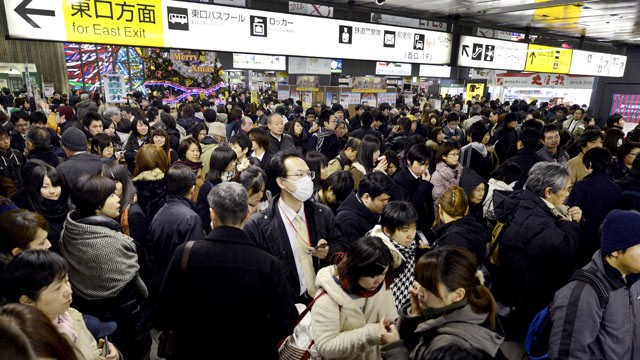
JR Sendai Station in Miyagi Prefecture is crowded with passengers as train services are suspended after an earthquake with a preliminary magnitude of 7.3 jolted northeastern and eastern Japan, Dec. 7, 2012. (Kyodo/Newscom)

There was never a risk of widespread tsunami warnings, according to the Pacific Tsunami Warning Center, and the alert was lifted about two hours after the quake struck.

All flights were grounded at the Sendai airport, and travelers were moved to the second and third floors in the terminal, according to an official.

The earthquake measured a 5 on the Japanese seismic scale of 1-7. By comparison, the historic March 2011 earthquake measured a 6.

No damage has been reported at monitoring posts and water treatment facilities at the reactors at the Fukushima Dai-ichi plant, the nuclear facility that was devastated by tsunami waters after the 2011 quake, according to the Tokyo Electric Power Company. All the workers were moved to higher ground on the site and told to stay inside after the tsunami warning.

Buildings in Tokyo swayed for at least several minutes after the earthquake.

Evacuations were ordered in seven cities in Iwate Prefecture, including Rikuzentakata and Kamaishi. As many as 4,000 people fled low lying areas in those cities.

Ten people were taken to hospitals, including a 75-year-old woman in Ishinomaki who fell while trying to evacuate, Japan's NHK news reported.

In the city of Natori, a 2-year-old boy was taken to the hospital after he hit his head during the quake. In the city of Tsuchiura, in the Ibaraki Prefecture, a 36-year-old woman was injured when a dresser fell on her.

The northeast region of Japan was hit with a magnitude-9.0 earthquake and ensuing tsunami March 11, 2011, that killed or left about 19,000 people missing.

All but two of Japan's nuclear plants were shut down for checks after the earthquake and tsunami caused meltdowns at the Fukushima Dai-Ichi nuclear plant.( Associated Press )


READ MORE - Tsunami Warning Lifted After Strong Earthquake Strikes Near Japan

Japan Dodges Tsunami After Quake


Japan Dodges Tsunami After Quake - A powerful 7.3 magnitude earthquake off the coast of Japan triggered a tsunami warning and evacuation orders in seven cities today, but the warning was lifted a short time later with few injuries and little damage.

The earthquake struck 150 miles off the coast of Miyagi prefecture just after 5 p.m. local time, followed by several aftershocks. Tsunami waves were recorded in at least five different locations, with the largest in Ishinomaki measuring at 3 feet, according to the Japan Meteorological Agency.

http://static.euronews.com/images_news/W500px_1203-japan-earthquake-damaged-boats.jpg

There was never a risk of widespread tsunami warnings, according to the Pacific Tsunami Warning Center, and the alert was lifted about two hours after the quake struck.

All flights were grounded at the Sendai airport, and travelers were moved to the second and third floors in the terminal, according to an official.

The earthquake measured a 5 on the Japanese seismic scale of 1-7. By comparison, the historic March 2011 earthquake measured a 6.

No damage has been reported at monitoring posts and water treatment facilities at the reactors at the Fukushima Dai-ichi plant, the nuclear facility that was devastated by tsunami waters after the 2011 quake, according to the Tokyo Electric Power Company. All the workers were moved to higher ground on the site and told to stay inside after the tsunami warning.

Buildings in Tokyo swayed for at least several minutes after the earthquake.

Evacuations were ordered in seven cities in Iwate Prefecture, including Rikuzentakata and Kamaishi. As many as 4,000 people fled low lying areas in those cities.

Ten people were taken to hospitals, including a 75-year-old woman in Ishinomaki who fell while trying to evacuate, Japan's NHK news reported.

In the city of Natori, a 2-year-old boy was taken to the hospital after he hit his head during the quake. In the city of Tsuchiura, in the Ibaraki Prefecture, a 36-year-old woman was injured when a dresser fell on her.

The northeast region of Japan was hit with a magnitude-9.0 earthquake and ensuing tsunami March 11, 2011, that killed or left about 19,000 people missing.

All but two of Japan's nuclear plants were shut down for checks after the earthquake and tsunami caused meltdowns at the Fukushima Dai-Ichi nuclear plant. ( Good Morning America )


READ MORE - Japan Dodges Tsunami After Quake

Tsunamis, Earthquakes Overdue in Lake Tahoe


Tsunamis, Earthquakes Overdue in Lake Tahoe — A tsunami-producing fault in Lake Tahoe is overdue for another earthquake, scientists said here yesterday (Dec. 4) at the annual meeting of the American Geophysical Union.

The West Tahoe Fault is capable of producing a magnitude-7.3 earthquake and tsunamis up to 30 feet (10 meters) high in the clear blue lake, where million-dollar homes line the shore, researchers said.

Earthquakes strike every 3,000 to 4,000 years on the fault, and the most recent shaker was 4,500 years ago, indicating the fault is overdue for another earthquake, said Jillian Maloney, a graduate student at the Scripps Institution of Oceanography in San Diego.

http://l.yimg.com/bt/api/res/1.2/nglXjGv81_Aadv7n33oY0w--/YXBwaWQ9eW5ld3M7Zmk9aW5zZXQ7aD00MDA7cT03OTtzbT0xO3c9NjAw/http://media.zenfs.com/en_US/News/LiveScience.com/FallenLeafLiDAR.jpg1354749515 
A lidar image of Fallen Leaf Lake in the Lake Tahoe Basin. The blue line is the West Tahoe Fault. The rainbow hues reflect the depth of the lake.

The West Tahoe fault defines the west shore of the lake, coming on shore at Baldwin Beach, passing through the southern third of Fallen Leaf Lake, and then descending into Christmas Valley near Echo Summit.

Underwater tracking

To trace the fault's history, Maloney and her colleagues examined data from a CHIRP seismic imaging system, which details underwater sediment layers at very high resolution. (CHIRP stands for compressed high intensity radar pulse.) The researchers correlated landslide deposits, which could be related to past earthquakes, throughout western Lake Tahoe and in small lakes immediately to the south with radiocarbon dates from the sediments.

The West Tahoe Fault has a complicated history, the analysis reveals. The fault appears to alternate between breaking all at once, in a 31-mile long (50 kilometer) fracture, and in smaller, shorter segments. The discovery has implications for the Tahoe's seismic hazard, because the size of an earthquake relates to the length of a fault rupture, Maloney said. The biggest earthquakes come from the longest fault fractures.

The correlations, while still at an early stage, indicate the last time the fault's entire length ruptured was 7,800 years ago, Maloney told OurAmazingPlanet. More recent quakes occurred on individual segments, she said.

Tsunami risk

Because the fault crosses the lake, scientists worry a future earthquake will cause a tsunami in Lake Tahoe. The monster waves could form in two ways: by the fault displacing ground under the lake, similar to Japan's Tohoku tsunami, or by causing landslides that displace the water. A combination of both could also create an even bigger wave.

Layers of sediment preserved in and around Lake Tahoe record evidence of past tsunamis, said Graham Kent, director of the Nevada Seismological Laboratory in Reno.

However, having smaller earthquakes on the West Tahoe Fault would be better for the ski town. "If it breaks up into multiple segments, it might not be as great a tsunami risk," Kent told OurAmazingPlanet.

The most recent earthquake in the Tahoe region was about 575 years ago, on the Incline Fault, which becomes active about every 10,000 to 15,000 years. Scientists estimate its earthquake size potential at magnitude 7.

At more than 1,645 feet (501 meters) deep, Lake Tahoe, which straddles the California and Nevada border in the seismically active Sierra Nevada region, is one of the world's deepest freshwater lakes. ( LiveScience.com )


READ MORE - Tsunamis, Earthquakes Overdue in Lake Tahoe

Pacific Voyage Finds a Sea of Floating Tsunami Debris


Pacific Voyage Finds a Sea of Floating Tsunami Debris - They were not signing on for a pleasure cruise, when Marcus Eriksen and 11 others climbed aboard the Sea Dragon in Tokyo a month ago.

The adventurers would sail over 4,000 miles of rough Pacific Ocean seas, finally limping into Hawaii this week, low on fuel and high on adrenaline.

The group was on a mission: looking to document any tsunami debris being pushed along by the current in the western half of the North Pacific.


http://l.yimg.com/bt/api/res/1.2/hRyAZvsJGVPuQzsnIFt80w--/YXBwaWQ9eW5ld3M7Y2g9MzU1O2NyPTE7Y3c9NjMwO2R4PTA7ZHk9MDtmaT11bGNyb3A7aD0zNTU7cT04NTt3PTYzMA--/http://l.yimg.com/os/152/2012/07/11/tsunami-jpg_163814.jpg


"While we were doing this, we were very much aware of the tragedy," Eriksen told ABCNews.

Eriksen, who has devoted a dozen years to studying plastic trash polluting the world's oceans, says the tsunami also gives scientists a unique opportunity that they couldn't create themselves.

"You can't [just] take an entire city of all the materials we consume and put it in the oceans," to see what happens, he said.

Debris from the tsunami in March of 2011 has started coming ashore on the West Coast of the United States and Canada - everything from part of a huge dock that washed up on the beach in Oregon, to a soccer ball.

Those pieces of debris were jutting high enough out of the ocean that they were driven eastward by the wind, but researchers on the 72-foot Sea Dragon were hunting for debris that was mostly submerged and subject to the ocean currents.

Their biggest find was half of a fishing boat, which Eriksen estimates was originally about 16 feet long. A quick dive underwater found a few barnacles and 50 or 60 fish living inside.

"What's now a wreck of a boat has become a floating reef system for this crowd," Eriksen wrote in his blog chronicling the journey.

He and his team are now working with the Japanese television network NHK to try to locate the owner of the fishing boat.

"My first question," Eriksen said. "Are you and your family, OK?"

He's hoping the boat was simply ripped from its mooring during the powerful tsunami and that no one was on board.

Tsunami debris aside, the Pacific Ocean "is one giant garbage patch", according to Eriksen.

His non-profit group, the 5 Gyres Institute, works to reduce plastics polluting the oceans. (A gyre is a large circular ocean current.) This was his 12th expedition and also included cataloguing plastic debris.

"We are in the middle of nowhere, and we are seeing one piece of trash every three and a half minutes," said Eriksen.

A marine research institute, Algalita, will analyze the garbage samples, as part their mapping of plastic debris in the North Pacific Ocean.

In addition to the Japanese fishing boat, the crew also found other remnants of the tsunami, including a truck tire still on the rim, and a tatami mat which may have been a piece of flooring. They also spotted a metal propane tank, a fishing buoy and a blue plastic bucket.

"My guess is there's not going to be a wave or avalanche of (tsunami) debris washing ashore," he said. "It is going to be a slow trickle over many years."

That slow trickle could still amount to quite a haul.

The Japan Minister of Environment estimated that 5 million tons of debris was washed into the ocean, and that about 70 percent of that sank near the coast of Japan. That leaves some 30 percent - 1.5 million tons of debris - that would have floated into the Pacific Ocean.

As the U.S. and Canadian governments continue to develop plans to handle all that oncoming debris, the 5 Gyres Institute is getting ready for its next mission. On Wednesday, a team heads out on a Lakes Expedition, for the first investigation of plastic pollution on the surface of Lakes Michigan, Huron and Erie. ( ABC News )


Blog : Paying The Highest
Post : Pacific Voyage Finds a Sea of Floating Tsunami Debris

READ MORE - Pacific Voyage Finds a Sea of Floating Tsunami Debris

Huge quakes off Indonesia stir panic, but no big tsunami


Huge quakes off Indonesia stir panic, but no big tsunami - A powerful 8.6 magnitude earthquake and a series of strong aftershocks struck off Indonesia on Wednesday, sending people scurrying from buildings as far away as southern India, but there seemed little risk of a disastrous tsunami as in 2004.

Indonesia said it was checking for damage and casualties but remarkably, no such reports had been received for several hours after the quakes, including in Aceh, the closest province and the area decimated by the disaster eight years ago.

However, some areas close to the epicenter are remote so it could take some time to find out if there was any damage.


http://l.yimg.com/bt/api/res/1.2/bOHv_kzmixKC3GAUCm9piw--/YXBwaWQ9eW5ld3M7Zmk9aW5zZXQ7aD00MjA7cT04NTt3PTYzMA--/http://media.zenfs.com/en_us/News/ap_webfeeds/d4c7116c4550850a0c0f6a706700f229.jpg
Acehnese men ride on a motorized pedicab as they evacuate to higher ground after a strong earthquake was felt in Banda Aceh, Aceh province, Sumatra island, Indonesia, Wednesday, April 11, 2012. Two massive earthquakes triggered back-to-back tsunami warnings for Indonesia on Wednesday, sending panicked residents fleeing to high ground in cars and on the backs of motorcycles. There were no signs of deadly waves, however, or serious damage, and a watch for much of the Indian Ocean was lifted after a few hours. (AP Photo/Heri Juanda)


Many people were frightened of further tremors.

"It's dark out here but I am scared to go home," said Mila, a 41-year-old woman taking refuge in the grand mosque in the town of Banda Aceh, the provincial capital.

"I just want to stay alert because I fear there will be more quakes coming. We are human, it is only natural that we have fear, but I really wish we will all be safe."

Waves of up to one meter (3.3 feet) high were seen near islands off Aceh, but Indonesia cancelled a warning for fresh tsunamis. It said the worst-hit area was the thinly populated island of Simeulue, off Aceh's southern coast.

The first quake struck at 4.38 a.m.EDT and an 8.2 magnitude aftershock just over two hours later, at 6.43 a.m. EDT. Two more strong aftershocks hit later.

The Hawaii-based Pacific Tsunami Warning Center also withdrew tsunami warnings for the entire Indian Ocean after keeping them in force for several hours.

"Level readings now indicate that the threat has diminished or is over for most areas," the agency's bulletin said.

Thailand and India also withdrew tsunami warnings.

Thailand, Indonesia, Sri Lanka and India were all badly hit in 2004. At least 230,000 people in 13 Indian Ocean countries were killed in the Boxing Day disaster that year, including 170,000 in and around Aceh alone.

Last year, an earthquake and tsunami off Japan's northeastern coast killed at least 23,000 people and triggered the world's worst nuclear crisis in 25 years after waves battered a nuclear power station.

On Wednesday, people near the coast in six Thai provinces were ordered to move to higher ground. Authorities shut down the international airport in the Thai beach resort province of Phuket.

The quakes were about 300 miles southwest of Banda Aceh, on the northern tip of Indonesia's Sumatra island, the U.S. Geological survey said. The first was at a depth of 20.5 miles.

Indonesia's disaster management agency said power failed in Aceh province and people were gathering on high ground as sirens warned of the danger.

"The electricity is down, there are traffic jams to access higher ground. Sirens and Koran recitals from mosques are everywhere," said Sutopo, spokesman for the agency.

"The warning system worked," Indonesian President Susilo Bambang Yudhoyono said.

Warning sirens also rang out across the Thai island of Phuket, a tourist hotspot that was one of the worst hit areas in the 2004 tsunami.

"Guests from expensive hotels overlooking Phuket's beaches were evacuated to the hills behind and local people were driving away in cars and on motorcycles. Everyone seemed quite calm, the warning had been issued well in advance," freelance journalist Apichai Thonoy told Reuters by telephone.

OUT ON THE STREETS

Indonesian television showed people gathering in mosques in Banda Aceh. Many others were on the streets, holding crying children.

In the city of Medan, a hospital evacuated patients, who were wheeled out on beds and in wheelchairs.

Wednesday's quakes were felt as far away as the Thai capital, Bangkok, and in southern India, hundreds of office workers in the city of Bangalore left their buildings while the port of Chennai closed down because of tsunami fears.

The quakes were in roughly in the same area as the 2004 quake, which was at a depth of 18 miles along a fault line running under the Indian Ocean, off western Indonesia and up into the Bay of Bengal.

Experts said Wednesday quakes were a "strike-slip" fault, meaning a more horizontal shift of the ground under the sea as opposed to a sudden vertical shift, and less risk of a large displacement of water triggering a tsunami.

"The nature of the sideways rupture and sideways movement is not predisposed to cause a bad tsunami, so almost certainly, the crisis has been avoided," said David Rothery, an expert at the Open University in the U.K.

The quakes were also felt in Sri Lanka, where office workers in the capital, Colombo, fled their offices.

Mahinda Amaraweera, Sri Lanka's minister for disaster management, called for calm while advising people near the coast to seek safety.

"I urge the people not to panic. We have time if there is a tsunami going to come. So please evacuate if you are in the coastal area and move to safer places," Amaraweera told a private television channel.

In Bangladesh, where two tremors were felt, authorities said there appeared to be no threat of a tsunami. Australia also said there was no threat of a tsunami there. ( Reuters )

READ MORE - Huge quakes off Indonesia stir panic, but no big tsunami

8.6-magnitude earthquake strikes off Indonesia, triggering tsunami watch


8.6-magnitude earthquake strikes off Indonesia, triggering tsunami watch – A tsunami watch was issued for countries across the Indian Ocean after a massive earthquake hit waters off Indonesia on Wednesday, triggering widespread panic as residents along coastlines fled to high ground in cars and on the backs of motorcycles.

Some were screamed "God is great" as they poured from their homes. Others, separated from relatives, cried as they ran frantically through the streets.


http://a57.foxnews.com/static/managed/img/U.S./396/223/IndonesiaEarthquake.jpg
April 11, 2012: In this image made from Indonesian television TV One, a woman hugging a girl uses a mobile phone shortly after they ran out from a building when a strong earthquake hit in Aceh in Indonesia.

The U.S. Geological Survey said the 8.6-magnitude quake was centered 20 miles beneath the ocean floor around 269 miles from Aceh's provincial capital.

The tremor was felt in Singapore, Thailand, Bangladesh, Malaysia and India. High-rise apartments and offices on Malaysia's west coast shook for at least a minute.

The Pacific Tsunami Warning Center in Hawaii said a tsunami watch was in effect for Indonesia, India, Sri Lanka, Australia, Myanmar, Thailand, the Maldives and other Indian Ocean islands, Malaysia, Pakistan, Somalia, Oman, Iran, Bangladesh, Kenya, South Africa and Singapore.

A tsunami watch means there is the potential for a tsunami, not that one is imminent.

Said, an official at Indonesia's Meteorology and Geophysics Agency who goes by only one name, said a tsunami warning has been issued for cities all along the coast of Sumatra island.

President Susilo Bambang Yudhoyono told reporters: "There is no tsunami reported so far, but we remain vigilant."

"Our warning system is working well, and I have ordered the national relief team to fly immediately to Aceh to ensure the situation is under control and to take any necessary action," he said.

Thanks God, from what I heard there is neither casualties reported nor major damage in Banda Aceh or other places," he added.

There was chaos in the streets, with fierce shaking continuing for nearly four minutes.

Patients in several cities poured out of hospitals, some with drips still attached to their arms. In some places, electricity was briefly cut.

"It wasn't the strongest quake I've felt," said 22-year-old Tuti Rahmi, while trying to reach her brother by phone.

"But it seemed to last forever," she said. "Hopefully there won't be too much damage."

One hour after the temblor, people were still standing outside their homes and offices, afraid to go back inside.

There were several strong aftershocks.

"I was in the shower on the fifth floor of my hotel," Timbang Pangaribuan told El Shinta radio from the city of Medan. "We all ran out. ... We're all standing outside now."

He said one guest was injured when he jumped from the window of his room.

Thailand's National Disaster Warning Center issued an evacuation order to residents in six provinces along the country's west coast, including the popular tourist destinations of Phuket, Krabi and Phang-Nga.

India's Tsunami Warning Center issued a tsunami warning for parts of the eastern Andaman and Nicobar islands.

In Tamil Nadu in southern India, police cordoned off the beach and used loudspeakers to warn people to leave the area.

Satheesh Shenoi, director of the Indian National Center for Ocean information Services, said the chance of a tsunami was diminishing.

"There are no indications of tsunami wave; the instruments are not showing any sea level change," he said.

The quake was felt in Dhaka, Bangladesh, where many people in the city's commercial Motijheel district left their offices and homes in panic and ran into the streets. No damage or causalities were reported.

In Male, the capital of the Maldives, buildings were evacuated.

Indonesia straddles a series of fault lines that makes the vast island nation prone to volcanic and seismic activity.

A giant 9.1-magnitude quake off the country on Dec. 26, 2004, triggered a tsunami in the Indian Ocean that killed 230,000 people, nearly three quarter of them in Aceh. ( foxnews.com )

READ MORE - 8.6-magnitude earthquake strikes off Indonesia, triggering tsunami watch

Alaskan coast guard watches as tsunami ghost ship drifts toward U.S. waters


Alaskan coast guard watches as tsunami ghost ship drifts toward U.S. waters -- A large and rusting ghost ship floating aimlessly off the Pacific coast is drifting towards Alaskan waters, setting off a series of tactical steps by the U.S. Coast Guard.

The unmanned 54-metre fishing vessel is at the forefront of tons of debris heading across the Pacific Ocean from last year's massive tsunami in Japan.


http://newsserve.net/i/20120403/2093-Alaskan-coast-guard-watches-as-tsunami-ghost-ship.jpg

The ship is about 150 kilometres west of the northern most tip of Haida Gwaii, or the Queen Charlotte Islands, off British Columbia's coast and appears to be heading north.

U.S. Coast Guard Petty Officer 1st Class David Mosley said Sunday the coast guard dropped a data marker on the ship Saturday so they would have a constant, real-time, position on the vessel.

Mosley said the key concern is if the ship moves north west over top of Haida Gwaii and into the body of water that divides Canada and the United States.

"Dixon Entrance ... is a pretty heavily travelled area for cargo ships, fuel ships, even cruise ships in the summer, so we have to be aware of what the overall danger is to the maritime traffic as well as the maritime environment," he said.

"It has the potential to be a hazard, especially with the unknown of what's on board, the direction that the vessel could be travel."

The vessel was swept out to sea along with an island of other debris when the tsunami hit Japan after the magnitude-9 earthquake struck last March.

Officials say the boat is a former squid fishing vessel that was based out of Hokkaido, Japan. It was located in the Oshawa Seamount area.

At first officials thought the ship was bound for Canadian waters, but Mosley said it now appears to be on a northerly course towards Alaska.

"All that superstructure up above the water line acts like a sail on a sailboat. If it's a good northerly wind, it will push it," he said. "Depending on the direction it goes, that's the window of time we have to respond to operate and ensure the safety of commercial vessels and the environment."

Mosley said a U.S. Coast Guard cutter would be sent out this week to assess the condition of the vessel.

"So we're looking at — do we work with other government agencies to go out and just sink it while it's still well off shore, or do we need to arrange to have a vessel come out and take it into tow and dispose of it in a way other than just going out and scuttling it. Those are all different things we have to look at."

In Canada, several government departments are watching the drifting vessel including Transport, Environment, Fisheries, Public Safety and National Defence.

A Transport Canada spokeswoman said marine currents and winds could make the vessel's destination very unpredictable and a warning has been issued to mariners to watch for the potential hazard.

"We will ensure that it does not wash ashore on the Canadian coast," Sau Sau Liu said.

Note to readers: This is a corrected story. A previous story said the ship was named the Oshawa Seamount. ( The Canadian Press )

READ MORE - Alaskan coast guard watches as tsunami ghost ship drifts toward U.S. waters

Coast Guard monitors ghost ship drifting northwest


Coast Guard monitors ghost ship drifting northwest — A derelict Japanese ship dislodged by last year's massive tsunami was drifting toward Alaska Monday, the U.S. Coast Guard said.

The shrimping vessel was floating slowly northwest in the Gulf of Alaska about 125 miles west of the nearest point of land — Forrester Island outside the Dixon Entrance, a maritime transportation corridor separating U.S. and Canada jurisdictions. The ship is heading in the direction of the southeast Alaska town of Sitka 170 miles to the north, traveling at about one mile per hour, Coast Guard spokesman David Mosley said.


http://l.yimg.com/bt/api/res/1.2/DFk7yTtMevf1rKJ0eS0PrQ--/YXBwaWQ9eW5ld3M7Y2g9NDE5O2NyPTE7Y3c9NjMwO2R4PTA7ZHk9MDtmaT11bGNyb3A7aD00MTk7cT04NTt3PTYzMA--/http://l.yimg.com/os/152/2012/04/03/2012-03-24T205210Z-1066627301-GM1E83P0DRR01-RTRMADP-3-CANADA-JAPAN-JPG_135110.jpg
Canada's Department of National Defence photograph shows a Japanese fishing vessel, which is believed have been lost as a result of last year's tsunami, that was sighted drifting 150 nautical miles of the southern coast of Haida Gwaii off the coast of British Columbia, March 20, 2012. According to Department of National Defence, the vessel is considered an obstruction to navigation, and a Notice to Shipping has been issued by the Canadian Coast Guard. The Department of National Defence confirmed that close visual aerial inspection and hails to the ship indicate there is no one on board. REUTERS/Department of National Defence/Handout (CANADA - Tags: ENVIRONMENT DISASTER SOCIETY) FOR EDITORIAL USE ONLY. NOT FOR SALE FOR MARKETING OR ADVERTISING CAMPAIGNS. THIS IMAGE HAS BEEN SUPPLIED BY A THIRD PARTY. IT IS DISTRIBUTED, EXACTLY AS RECEIVED BY REUTERS, AS A SERVICE TO CLIENTS


There are no immediate concerns regarding the community of about 9,000, however. Mosley said the town is just a reference point at this time and that currents could always change.

"Our main concern is maritime traffic," he said. "We're trying to minimize any safety concerns, alerting vessels. We don't want any vessels to run into it."

A Coast Guard C-130 was heading to the ship Monday to pinpoint the exact location and check if a data buoy was successfully dropped on it Saturday.

The vessel has been adrift since it was launched by the tsunami caused by the magnitude-9.0 earthquake that struck Japan last year. About 5 million tons of debris were swept into the ocean by the tsunami.

The ship has been identified as coming from Hokkaido, Japan.

Beside boat traffic, another concern is the ship's impact on the maritime environment after floating at sea more than a year. What's on board is unknown. Also unknown is whether the ship is carrying fuel.

The vessel, named Ryou-Un Maru, is believed to be 150 to 200 feet long, according to Mosley.

Officials are studying various options on how to deal with the ship, including scuttling it at sea or towing it to land.

The Japan earthquake triggered the world's worst nuclear crisis since the Chernobyl accident in 1986, but Alaska state health and environmental officials have said there's little need to be worried that debris landing on Alaska shores will be contaminated by radiation. They have been working with federal counterparts to gauge the danger of debris including material affected by a damaged nuclear power plant, to see if Alaska residents, seafood or wild game could be affected.

In January, a half dozen large buoys suspected to be from Japanese oyster farms appeared at the top of Alaska's panhandle and may be among the first debris from the tsunami.

The United States needs to hurry up and prepare for debris from the tsunami, U.S. Sens. Mark Begich of Alaska and Maria Cantwell of Washington state said last week in Seattle, before the ship crossed into U.S. waters from the coast of Canada. The Democratic senators said they're seeking three things from the federal government, including emergency research money to better understand where the debris is going and how much can be expected on U.S. shores.

At the time, Begich said he was worried the derelict vessel might end up in Alaska waters.

"My understanding is they know the owner and he has indicated they don't want it," Begich said Friday. "Neither do we."

Begich was not available for comment Monday. His spokeswoman, Julie Hasquet, repeated his call for a plan and funding as a necessity.

"The rapid pace at which events are changing and debris is moving only underscores that need," she said. ( Associated Press )

READ MORE - Coast Guard monitors ghost ship drifting northwest

Japan's wall of sighs: 750,000 images of loved ones salvaged from tsunami carnage that have been heart-breakingly damaged beyond recognition


Japan's wall of sighs: 750,000 images of loved ones salvaged from tsunami carnage that have been heart-breakingly damaged beyond recognition - Another nuclear reactor taken offline today, leaving only one power station left working in Japan

These are the eery family portraits of unknowns found strewn amongst the carnage of Japan's Tsunami.

Emergency services salvaged over 750,000 images in Yamamoto and returned most of them to their owners as they helped clear up the aftermath of the deadly natural disaster.

But over 30,000 were damaged beyond recognition, with the incumbents' faces often spookily washed away by the millions of tonnes of water that spilled onto the land.


This is one of the eery family portraits washed up on shore after Japan's tsunami

This is one of the rather spooky family portraits washed up on shore after japan's tsunami


Of the 750,000 images found in Yamamoto, over 30,000 were damaged beyond recognition

Of the 750,000 images found in Yamamoto, over 30,000 were damaged beyond recognition


Emergency services salvaged over 750,000 images in Yamamoto and returned most of them to their owners, this is one of the unlucky ones

Emergency services salvaged over 750,000 images in Yamamoto and returned most of them to their owners, this is one of the unlucky ones


Dozens of snaps show people in happier times - smiling, playing, laughing - but crucially their identities have been lost to the devastating effects of the water.

Holiday snaps, weddings, baby births and children's birthdays - all documented in the striking series of images found discarded about the coastal town at the heart of the disaster zone.

In one poignant image a suburban street, completely obliterated by the surging tides, can be seen before the diaster - but with the middle water damaged leaving a simply white space.

Volunteer group Salvage memory decided to take ownership of the images and turn them into a permanent memorial to the victims.


The missing images now form an exhibition currently showing in New York

The missing images now form an exhibition currently showing in New York


Professional photographer, Munemasa Takahashi, has taken it upon himself to photograph the 30,000 untraceable snaps.

Professional photographer, Munemasa Takahashi, has taken it upon himself to photograph the 30,000 untraceable snaps.


The exhibition hopes to reunite the photographs to their original owners

The exhibition hopes to reunite the photographs to their original owners


Sako Shimizu, who was luckily in Tokyo when the disaster occurred, said: 'They stir up and sear people's imagination because of the water damage.

'Although the faces are mostly unrecognisable, you can tell that they capture happy moments.

'The disaster affected everyone. Most of the victims are just statistics which lessen the feelings towards them.

'But these photos make viewers think of them and remember them on a more personal level, and hope they survived the disaster.

Someone's holiday snaps of skyscapers form part of the exhibition

Someone's holiday snaps of skyscapers form part of the exhibition


This person's face has been completely obscured by the water damage from the tsunami

This person's face has been completely obscured by the water damage from the tsunami


Volunteers numbering nearly 500 are still helping authorities sieve through the bundles of images rescued - and are using social media to help trace those seen in them.

Sako added: 'One of our volunteers is actually from Yamamoto where all the images were recovered from.

'He was thankfully out of town on a business trip and his house was too badly affected by the tsunami. But the earthquake that followed partially destroyed it.

'His wife and five-year-old daughter evacuated from their town up north to Hakkaido. He is still faced with living away from his family.


One lucky man was reunited with an old photo, thanks to it being on display at the exhibition

One lucky man was reunited with an old photo, thanks to it being on display at the exhibition


The images were found discarded about the coastal town at the heart of the disaster zone

The images were found discarded about the coastal town at the heart of the disaster zone


He, alongside the other volunteers, have created an exhibit to display the poignant photos and are using the money raised to help support victims in Yamamoto.

The exhibit will be on display in New York between April 2 and April 27.

'It is also very strange for him as he knew lots of the people in the images, but didn't know if they were alive or safe and well.'

Professional photographer, Munemasa Takahashi, has taken it upon himself to photograph the 30,000 untraceable snaps.


JAPAN SUFFERS POST-TSUNAMI POWER CRISIS

Another Japanese nuclear reactor was taken off line for maintenance on Monday, leaving the country with only one of its 54 reactors operational following last year's devastating earthquake and tsunami.


The last reactor is expected to be shut down by early May, raising the possibility of power shortages across the nation as demand increases in the hot summer months.The No. 6 reactor at the Kashiwazaki-Kariwa complex was taken off line early Monday by the Tokyo Electric Power Co.


The utility also runs the plant in Fukushima, northeast of Tokyo, that suffered meltdowns, explosions and radiation leaks after the March 11 quake and tsunami.Japanese reactors are taken off line every 13 months for regular checks.


With concerns over nuclear safety high following the Fukushima crisis, none of the reactors that have been shut down for checks, and none that were already off line at the time of the disaster, have been allowed to restart. The last reactor, on the northern island of Hokkaido, will be shut down in May.


The timing for when any reactors will be restarted remains unclear. Before the crisis, Japan depended on nuclear power for one-third of its electricity. Japan's government wants to restart reactors as soon as 'stress tests' prove they are safe, but faces strong public opposition.


Local leaders, fearing a political backlash, are reluctant to give their approval.Authorities have required all reactors to undergo the stress tests and make necessary modifications to improve safety. The stress tests, similar to those used in France and elsewhere in Europe, are designed to assess how well the plants can withstand earthquakes, tsunamis, storms, loss of power and other crises.


Prime Minister Yoshihiko Noda has promised to reduce Japan's reliance on nuclear power over time and plans to lay out a new energy policy by the summer.


In the meantime, Japan has temporarily turned to oil and coal generation plants to make up for the shortfall, and businesses have been required to reduce electricity use to help with conservation efforts. ( dailymail.co.uk )


READ MORE - Japan's wall of sighs: 750,000 images of loved ones salvaged from tsunami carnage that have been heart-breakingly damaged beyond recognition